
July 9, 2026 · 7 minute read
| The short answer:
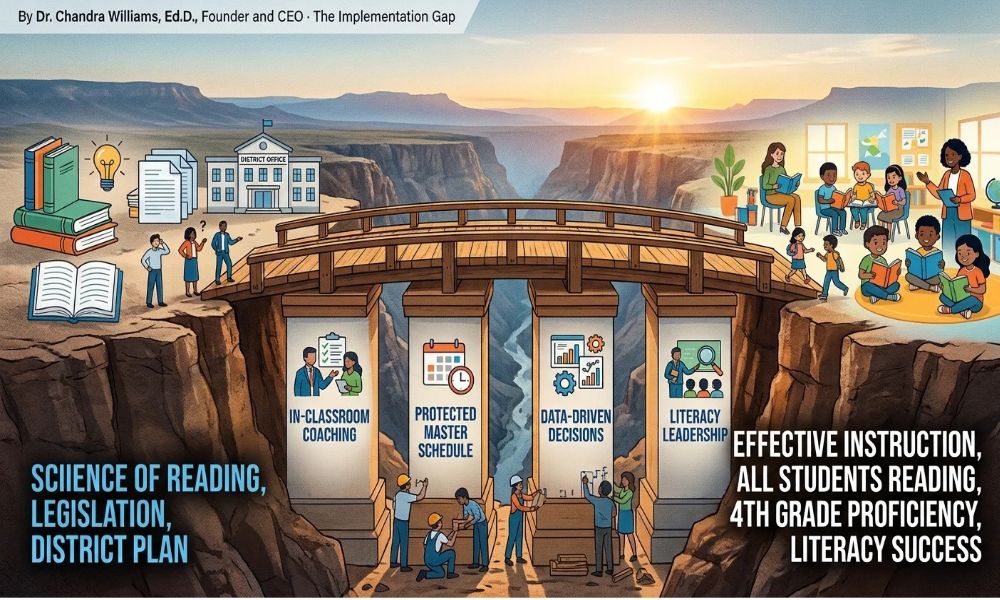
The implementation gap in literacy is the distance between the reading plan a district adopts and the instruction students actually receive. It is why the science of reading can be settled, legislated, and funded while 40 percent of American fourth graders still read below basic. The gap is not closed by purchasing anything. It is closed with coaching that transfers training into practice, master schedules that protect instruction, data routines that end in decisions, and leaders who know what strong reading instruction looks like. |
I want to start with a sentence I have said in more district boardrooms than I can count, usually right after someone slides a disappointing benchmark report across the table:
| You do not have a curriculum problem. You have an implementation gap. |
It is rarely what leaders expect to hear from a consultant, because the education industry has trained them to expect a pitch: a new program, a new platform, a new binder. But I sat in the principal’s chair for eight years before founding the Center for Student Achievement Solutions, and the scores had my name on them too. I know what it feels like to have done everything the plan required and still watch the numbers refuse to move. This article is the explanation I wish someone had given me then.
The numbers that do not add up
Consider three facts side by side.
First, the science is settled. The National Reading Panel (2000) established the essential components of reading instruction more than two decades ago, and the research base for explicit, systematic teaching, what practitioners now call structured literacy, has only deepened since.
Second, the policy followed. According to Education Week’s ongoing legislative tracker, more than 40 states plus the District of Columbia have passed laws or implemented policies on evidence-based reading instruction. The science of reading is not a movement anymore; in most of the country, it is the law.
Third, the outcomes did not. The NAEP 2024 Reading Assessment reported that 40 percent of U.S. fourth graders scored below NAEP Basic, the largest share in the assessment’s history. Read those three facts again in order: settled science, sweeping legislation, worsening results.
When the plan is right and the outcome is wrong, the problem lives in the space between them. That space has a name.
The implementation gap, defined
The implementation gap in education is the distance between what a system has adopted and what its students experience. In literacy, it shows up in four specific places, and after years inside hundreds of classrooms, I can tell you it almost always lives in the same four:
1. The transfer gap. Teachers received training on the new curriculum, usually one day, sometimes two, and then were left alone with it. Knowing is not the barrier; transfer is. In their landmark synthesis of professional development research, Joyce and Showers (2002) found that training built on theory, demonstration, and practice alone produced classroom implementation for only a small fraction of teachers, while the same training paired with ongoing, in-classroom coaching produced implementation for roughly 95 percent. The single most expensive line item in most literacy budgets, professional development, is routinely purchased in the one form the research says does not transfer.
2. The schedule gap. Print any master schedule and try to find the daily, protected foundational skills block. If you cannot find the minutes, neither can students. The schedule is not a logistics document; it is the district’s actual priority list, written in ink.
3. The data gap. Schools have never collected more reading data and acted on less of it. Screeners identify who is at risk; they were never designed to say why, or to change anything by themselves. Data that never alters an instructional minute was collected for nothing. The strongest systems we work with end every data meeting with a named change, an owner, and a check-back date.
4. The leadership sight gap. Torgesen (2004) documented how rarely students who leave the primary grades as poor readers catch up without markedly intensified support, which means the adults’ response time is the whole game. Yet many building leaders were never trained to recognize strong reading instruction when they see it. Walkthroughs measure compliance instead of learning, and feedback arrives weeks late or never.
Notice what is absent from that list: the curriculum. In nearly every struggling adoption we audit, the materials were adequate. What was missing was the system around them.
Why “buy something new” keeps failing
There is a structural reason you have probably never heard this framing from the companies you buy from: every major literacy vendor sells a product, and admitting an implementation gap indicts the product. So the industry’s answer to a stalled adoption is, reliably, another adoption. Districts cycle through programs the way a struggling reader cycles through interventions, and for the same reason: the core system was never fixed.
An August reading problem handled in August costs one adult and thirty minutes a day. The same problem in third grade, as Torgesen’s research warned two decades ago, costs a specialist, a schedule, and a childhood. Every year an implementation gap goes unnamed, that bill compounds.
What closing the gap actually looks like
|
FROM THE FIELD 11 of 11Every one of our partner schools in one New York City community school district improved across three consecutive school years, through principal turnover and staffing churn. In one building, kindergartners went from 25 percent at or above benchmark to 86 percent in a single year, verified against Acadience source data. Read the full case study. |
None of that came from a purchase. It came from a sequence, the same one we now run in every partnership and call the CSAS 90-Day Implementation Cycle:
See clearly. Audit instruction, schedules, data systems, and beliefs before launching anything new. You cannot fix what you have not honestly seen.
Protect the core. Rebuild the master schedule around daily foundational skills instruction, and pair every training hour with coaching so knowledge becomes practice. Structured literacy coaching is where the transfer gap closes.
Make data decide. Install data meetings that end in decisions, move intervention groups on evidence every six to eight weeks, and celebrate early wins loudly enough that skeptics lean in.
Then repeat the cycle at a higher altitude. That is the entire secret, and it is unglamorous on purpose: systems outlast enthusiasm, budgets, and even the leaders who build them.
Three questions to ask your team this month
If you lead a school, a district, or a state system, you can locate your own implementation gap before the first bell rings:
One: What percentage of our professional learning budget funds transfer, meaning coaching, rather than exposure, meaning workshops? Two: Can I find the protected daily foundational skills minutes on every master schedule in the district? Three: Did our last three data meetings end with a named instructional change, an owner, and a check-back date?
If any answer makes you wince, you have found the gap, and finding it is genuinely the hard part. Naming the implementation gap is the moment a district stops shopping and starts building. Over the next several months on this blog, and in our monthly newsletter The Click, we will hand you the tools we use to close it: the audits, the schedules, the data meeting protocols, and the coaching structures, free, because the science of reading implementation should not be a trade secret.
Get the signal, not the noise.The Click is our monthly newsletter for leaders who build readers: one evidence-based argument, one research translation, one move you can execute, every second Tuesday. Free, and leaders tell us it is the only one they finish. |
FAQ
What is the implementation gap in education?
The implementation gap is the distance between the instructional plan a school or district adopts and the instruction students actually receive. In literacy, it is the space between the science of reading a district has purchased, legislated, or trained for and the daily classroom practice that determines whether children learn to read. It is measured in coaching, schedules, data habits, and leadership practice rather than in materials.
Why do literacy curriculum adoptions fail to raise reading scores?
Most adoptions fail on transfer, not on materials. Research by Joyce and Showers found that training built on theory, demonstration, and practice alone produces classroom implementation for only a small fraction of teachers, while training paired with ongoing coaching produces implementation for the vast majority. A curriculum plus a workshop changes what teachers know; coaching, protected schedules, and data routines change what students experience.
How long does it take to close the implementation gap?
Meaningful movement begins within the first 90 days when the work follows a disciplined sequence: audit honestly, protect core instruction in the master schedule, and install data meetings that end in decisions. Verified turnarounds typically show measurable benchmark growth within one school year and sustained gains across two to three years when the systems, not just the enthusiasm, are built to last.
About the author: Dr. Chandra Williams, Ed.D., is the founder and CEO of the Center for Student Achievement Solutions. A career educator who spent eight years as a school principal, she leads CSAS’s partnerships with schools and districts nationwide, including a multi-year Brooklyn partnership where all eleven partner schools improved for three consecutive years. Her team delivers structured literacy coaching, MTSS and reading intervention systems, and literacy leadership development, built on one conviction: educators do not need another vendor. They need a partner in the building.
References: National Assessment of Educational Progress (2024), Reading Assessment, Grade 4. National Reading Panel (2000), Teaching Children to Read. Joyce, B., and Showers, B. (2002), Student Achievement Through Staff Development, 3rd ed. Torgesen, J. K. (2004), Avoiding the Devastating Downward Spiral. Education Week, science of reading legislation tracker. District results verified against Acadience Reading source data.