
July 14, 2026 · 5 minute read
| The short answer:
June’s reading results are built in July. Summer school improvement planning comes down to auditing five systems while the building is quiet: the master schedule, the assessment calendar with its decision rules, the intervention design, the training-to-coaching pairing, and the walkthrough rhythm. Then the one most principals skip: their own calendar. Fix these five on paper in July and September runs them for you; skip them and October fixes them for you, expensively. |
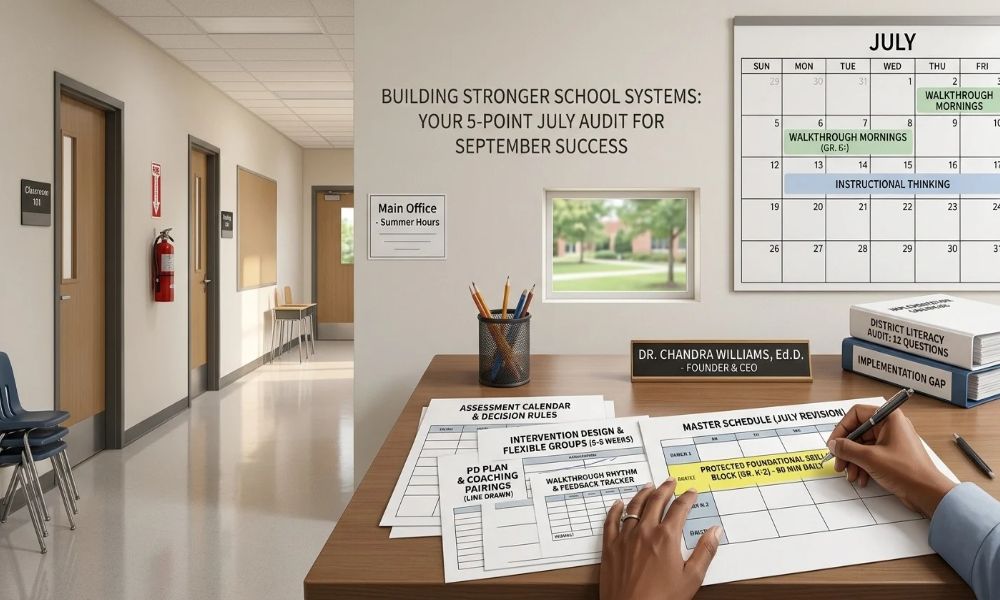
I loved my building in July. Eight years in the principal’s chair taught me that the quiet weeks of summer are the only time a leader gets to work on the school instead of in it, and that the principals whose scores moved were the ones who spent July auditing systems, not decorating bulletin boards. Here are the five audits, in the order I run them with partner principals every summer.
1. The master schedule. Print it and try to find the daily, protected foundational skills block in every early-grade classroom. If you cannot find the minutes, neither can students. The schedule is your real priority list, written in ink, and July is the only month it bends without a fight. We wrote a full guide to building it: the master schedule is the strategy.
2. The assessment calendar, with decision rules attached. Screening dates are probably set. The audit question is different: for each assessment, what decision will it drive, who makes it, and by what date? Data with no decision attached is a field trip. Write the placement rules in July, before the data arrives with opinions of its own.
3. The intervention design. Two tests. First, intervention supplements core instruction and never replaces it: no student leaves grade-level reading to receive reading help. Second, groups are skill-based and scheduled to move every 6 to 8 weeks. If last year’s groups were set in October and dissolved in June, this is your July project.
4. The training-to-coaching pairing. Pull the PD plan and draw a line from every training day to its follow-up coaching. Joyce and Showers (2002) found that training alone transfers to classroom practice for only a small fraction of teachers, while training paired with in-classroom coaching reaches roughly 95 percent. Any training day without a coaching line is a day you are buying twice.
5. The walkthrough rhythm. Decide now: which days, which look-fors, and how feedback reaches teachers within 48 hours. A rhythm decided in July survives September; a rhythm improvised in September rarely survives October.
The audit most principals skip
Your own calendar. Block the walkthrough mornings, the data meetings, and one weekly hour of instructional thinking now, in July, before the year books them for you. The buildings we serve that sustain growth, including a Brooklyn district where all eleven partner schools improved three years running, share this trait: the leader’s calendar matches the leader’s priorities, and both were set in the summer.
Every one of these audits is a doorway into the same larger idea: the implementation gap, the distance between the plan your school has and the instruction your students receive. July is when that distance is cheapest to close, and our leadership development work exists for principals who want a partner in the closing.
Run the full audit before August.The District Literacy Audit: 12 questions across instruction, professional learning, schedules, and leadership, with evidence prompts and scoring. Free, and built for exactly this month. |
FAQ
What should principals audit over the summer?
Five systems: the master schedule (a protected daily reading block in every early-grade room), the assessment calendar with written decision rules, the intervention design (supplemental, flexible, reviewed every 6 to 8 weeks), the pairing of every training day with follow-up coaching, and the walkthrough-and-feedback rhythm. Then the leader’s own calendar.
How do I prepare my school’s literacy plan in July?
Work on paper while the building is quiet: rebuild the schedule around reading first, write placement decision rules before data arrives, draw a coaching line from every PD day, and block your own instructional leadership time. Systems decided in July run themselves in September.
What systems predict a strong school year start?
Protected instructional minutes, decision rules that make data actionable within days, and a feedback rhythm teachers can count on. Schools with these three on paper before August consistently outpace schools with more initiatives and less structure.
About the author: Dr. Chandra Williams, Ed.D., is the founder and CEO of the Center for Student Achievement Solutions. A career educator who spent eight years as a school principal, she leads CSAS’s partnerships with schools and districts nationwide, including a multi-year Brooklyn partnership where all eleven partner schools improved for three consecutive years. Her team delivers structured literacy coaching, MTSS and reading intervention systems, and literacy leadership development, built on one conviction: educators do not need another vendor. They need a partner in the building.
References: Joyce, B., and Showers, B. (2002), Student Achievement Through Staff Development, 3rd ed. District results verified against Acadience Reading source data.