
July 28, 2026 · 5 minute read
| The short answer:
the best phonemic awareness warm up activities share three traits: they are daily, they are fast, and they need zero materials. Ten minutes in four rounds, ear tuning, blending, segmenting, and manipulation, delivered at a brisk pace with every voice answering on signal. Run it every morning and the sound work that powers decoding gets stronger on schedule; run it in occasional big doses and it fades. Small, daily, and joyful beats long and rare, every time. |
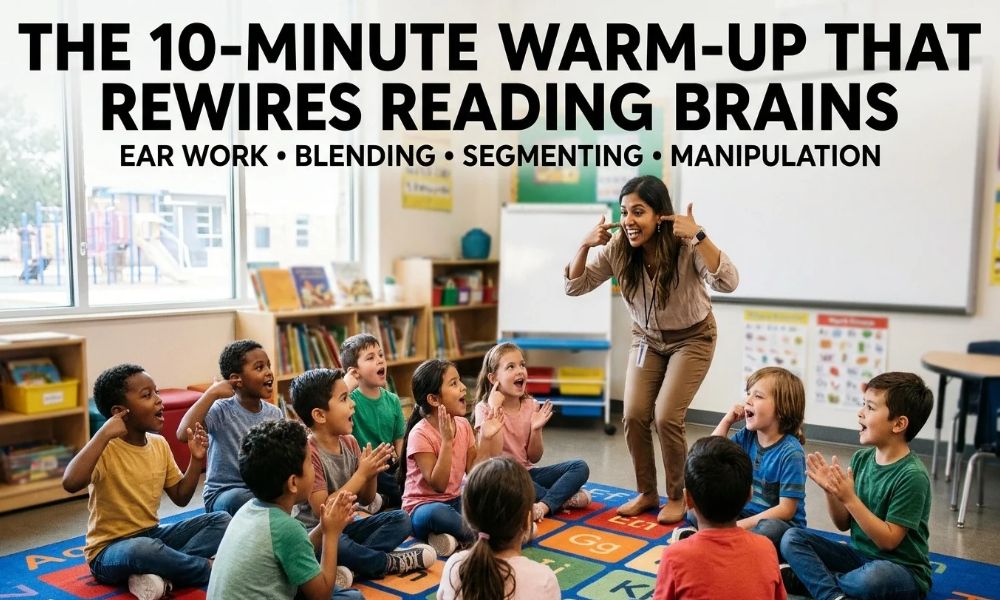
Some of the most powerful instruction I have ever coached needs no copies, no devices, and no prep. It is ten minutes of sound work at the top of the literacy block, and in classroom after classroom I have watched it quietly separate the rooms where decoding clicks from the rooms where it stalls. Here is the routine, exactly as our coaches launch it with partner teachers.
Why sounds come first
The National Reading Panel (2000) named phonemic awareness among the essential components of reading instruction for a reason: before letters can map to sounds, students have to hear the sounds. Ehri’s research on orthographic mapping (2014) describes the mechanism, readers bond spellings to pronunciations to store words for instant retrieval, and that bonding runs on phonemic skill. Ten daily minutes of ear work is not a nicety before the real lesson. It is the substrate the real lesson sticks to.
The four rounds
Round 1, minutes 1-2: tune the ears. Quick rhymes, odd-one-out, first-sound hunts. Playful on purpose; you are waking up the listening.
Round 2, minutes 3-5: blend. You give the sounds, students give the word, chorally, on your signal. Start with two and three phonemes and climb.
Round 3, minutes 6-8: segment. Reverse it: you give the word, students break it into sounds, tapping or counting on fingers. Segmenting is spelling’s engine room.
Round 4, minutes 9-10: manipulate. Delete, substitute, swap: say meat without the m; change the s in sat to fl. Manipulation is the heavy lift that predicts the strongest decoders, so end here while energy is high.
The delivery rules that make it work
Every voice, every time: responses are choral, on a signal, so all students practice instead of the fast five. Brisk pace, warm tone: this should feel like a game with standards. Errors are data: model the correct answer, have everyone repeat it, move on. And anchor it to the schedule, same ten minutes, every day, so it survives busy weeks. In our partner classrooms it anchors on day four of the first ten days and never leaves.
Ten minutes sounds too small to matter. So does daily interest, until June. This routine is one of the cheapest closures of the implementation gap a classroom can buy, and it sits at the heart of our structured literacy coaching because teachers master it in a week and keep it for a career.
Get the warm-up, scripted and free.The 10-Minute Phonemic Awareness Warm-Up: all four rounds with example sets, signals, and the pacing guide. Zero prep, zero materials, ready for the first morning of school. |
FAQ
How long should a phonemic awareness warm-up be?
About ten minutes, daily. Short, brisk, distributed practice builds phonemic skill more reliably than occasional long sessions, and ten minutes protects the rest of the literacy block.
What does a daily phonemic awareness routine include?
Four rounds: ear-tuning play (rhyme and first sounds), blending sounds into words, segmenting words into sounds, and manipulating phonemes through deletion and substitution, all delivered chorally at a game-like pace with no materials.
What grades need daily phonemic awareness practice?
Kindergarten through second grade as core instruction, and any older student whose assessment shows gaps in blending, segmenting, or manipulation. The routine scales up in difficulty, not in minutes.
About the author: Dr. Chandra Williams, Ed.D., is the founder and CEO of the Center for Student Achievement Solutions. A career educator who spent eight years as a school principal, she leads CSAS’s partnerships with schools and districts nationwide, including a multi-year Brooklyn partnership where all eleven partner schools improved for three consecutive years. Her team delivers structured literacy coaching, MTSS and reading intervention systems, and literacy leadership development, built on one conviction: educators do not need another vendor. They need a partner in the building.
References: National Reading Panel (2000), Teaching Children to Read. Ehri, L. C. (2014), Orthographic Mapping in the Acquisition of Sight Word Reading.