
July 30, 2026 · 5 minute read
| The short answer:
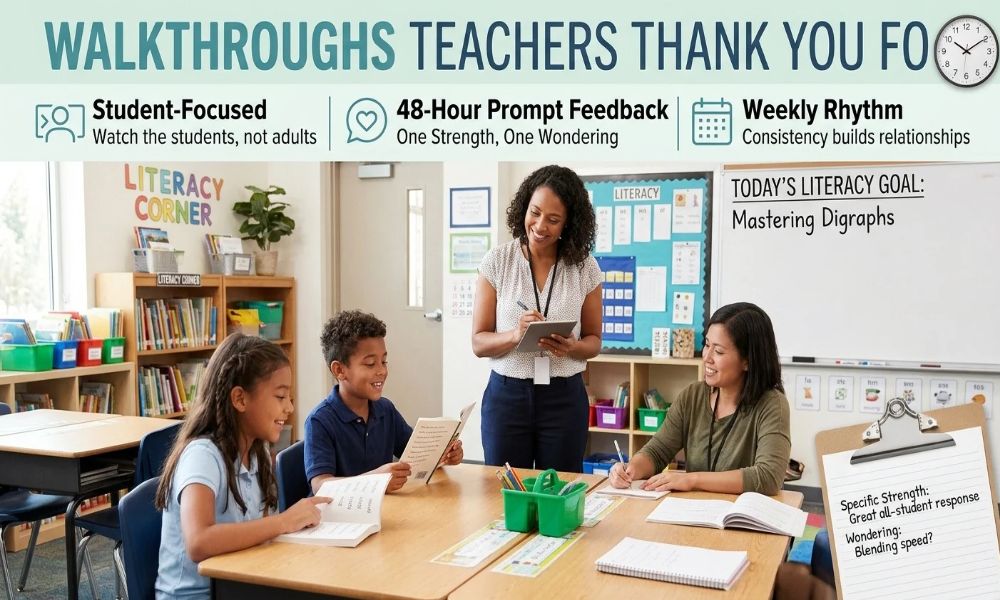
instructional walkthrough feedback earns gratitude instead of dread when three things change: leaders watch what students are doing rather than whether adults are complying, every visit produces one specific strength and one genuine wondering within 48 hours, and visits are short and weekly rather than long and rare. Ten minutes, student-focused, warmly and promptly fed back: that is the walkthrough teachers start inviting you to. |
Early in my principalship, a teacher told me something I have never forgotten: when you walk in with that clipboard, my students get my nerves instead of my teaching. She was right, and she handed me the redesign brief for every walkthrough I have done since. Walkthroughs are the highest-leverage habit in a literacy leader’s week, and also the easiest to do in a way that costs trust instead of building it. Here is the version teachers thank you for.
Watch the students, not the adults
Compliance walkthroughs check whether the teacher is on the right page. Learning walkthroughs watch the students, because students display the truth without knowing it. Are all voices responding on signal, or the same five? Are decodable texts in hands and eyes on print? When an error happens, does it get corrected and practiced, or passed over? Can a random student tell you what they are learning to do as a reader? Ten minutes of student-watching tells you more than an hour of lesson-plan review, and it changes how your presence feels in the room: you came to see their readers, not to catch them.
The 48-hour warm note
Feedback that arrives weeks late lands as evaluation; feedback that arrives within 48 hours lands as attention. Keep it small and honest: one specific strength, named precisely (your signal-to-response routine had every voice in the room working), and one genuine wondering, asked as a colleague (I am curious what would happen if the blending round moved faster). Teachers can build on that by Friday. What gets noticed specifically gets repeated, and that is the entire theory of action.
Small and weekly beats long and rare
The math favors frequency: ten minutes in eight classrooms a week, every week, outperforms a formal hour in each room once a semester, because instruction improves through reps and relationship, not through events. It also keeps your own eyes calibrated before data arrives with surprises. Torgesen (2004) documented how little time struggling readers can afford to lose, which makes the leader’s response speed part of the intervention. You cannot respond to what you have not seen this week.
In the Brooklyn district where all eleven partner schools improved three years running, walkthrough rhythm was one of the quiet constants, including the building whose kindergartners rose from 25 to 86 percent at benchmark in a single year. Set the rhythm now, in July, alongside the rest of the summer audit: it is the leadership habit that makes every other system visible, which is why it anchors our leadership development work and our approach to closing the implementation gap.
Get the Walkthrough Look-Fors, free.The literacy walkthrough tool our partner principals carry: student-focused look-fors by domain, the 48-hour feedback frame, and the weekly rhythm planner. |
FAQ
What should leaders look for in a literacy walkthrough?
Student evidence: all-student response routines working, decodable or grade-level text in hands, errors corrected and practiced, and students able to name what they are learning to do as readers. Student behavior reveals instruction more honestly than adult compliance does.
How fast should walkthrough feedback reach teachers?
Within 48 hours, in a short warm note: one precisely named strength and one genuine wondering. Prompt, specific feedback lands as attention and gets used; delayed feedback lands as evaluation and gets defended against.
How do walkthroughs build trust instead of fear?
Shift the object from adults to students, keep visits short and weekly so they are ordinary rather than ominous, and let the first feedback teachers receive be a named strength. Consistency plus warmth turns the principal’s presence into support.
About the author: Dr. Chandra Williams, Ed.D., is the founder and CEO of the Center for Student Achievement Solutions. A career educator who spent eight years as a school principal, she leads CSAS’s partnerships with schools and districts nationwide, including a multi-year Brooklyn partnership where all eleven partner schools improved for three consecutive years. Her team delivers structured literacy coaching, MTSS and reading intervention systems, and literacy leadership development, built on one conviction: educators do not need another vendor. They need a partner in the building.
References: Torgesen, J. K. (2004), Avoiding the Devastating Downward Spiral. District results verified against Acadience Reading source data.