
July 23, 2026 · 5 minute read
| The short answer:
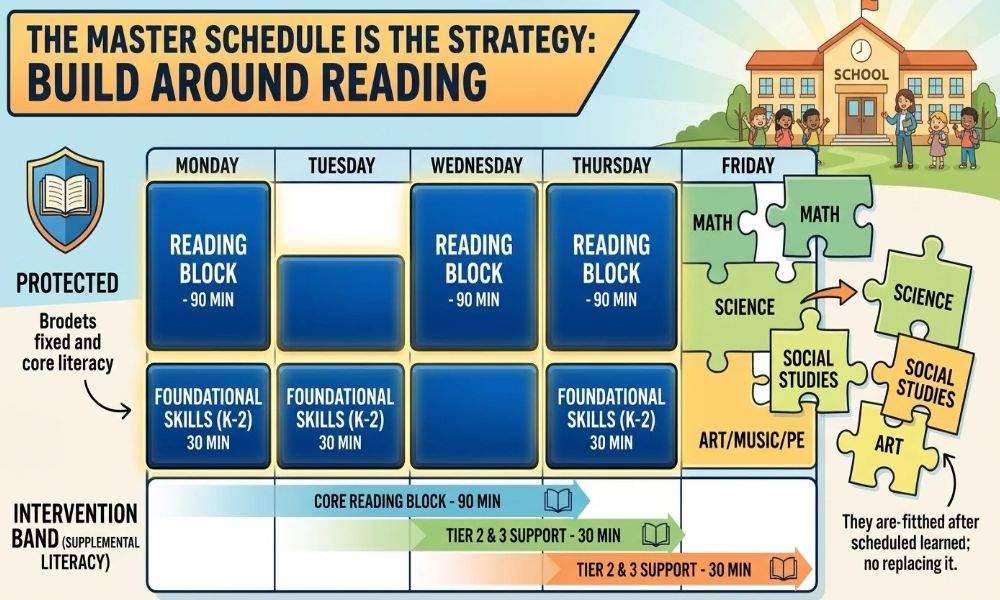
an elementary master schedule with a protected literacy block is not a logistics document; it is the school’s actual strategy, written in ink. Build it in this order: place the daily foundational skills block and the core reading block first, schedule intervention as a separate supplemental layer so no student ever misses core reading to receive reading help, then let everything else negotiate for what remains. Unprotected reading minutes lose every tie, and by June the ties add up to a grade level. |
Show me a school’s master schedule and I will tell you its priorities more accurately than its mission statement will. I mean that literally: in eight years as a principal and years since auditing schedules for partner districts, I have never seen strong reading outcomes sitting on top of a schedule that treated reading as one more block to fit in. The schedule is the strategy. Here is how to build it like one, while it is still July and the grid still bends.
Why reading loses every tie
Nobody votes to cut reading. It loses by tiebreaker: the assembly that needs a slot, the specials rotation that only works one way, the intervention pullout that has to happen sometime. Each decision is reasonable; the sum is a reading block nibbled to a nub. Torgesen (2004) documented how rarely readers who fall behind in the primary grades catch up without markedly intensified support, which means those nibbled minutes are not neutral. They compound, and the interest is charged to your most fragile readers.
The non-negotiables, placed first
1. The daily foundational skills block, K-2. Explicit, systematic, and findable on the grid in every classroom, every day. If a visitor cannot locate it in thirty seconds, it is not protected.
2. The full core reading block, every grade, every student. Core is for everyone. No pullout, service, or elective schedules against it.
3. Intervention as a supplemental layer. Build a dedicated intervention band so support adds minutes instead of replacing them. The rule our partner schools schedule by: supplement, never supplant. A struggling reader pulled from core reading to receive reading intervention is running a deficit dressed as a service. In tiered terms, that means core Tier 1 instruction for all (our partner schools typically run UFLI Foundations in K-2 and HMH Into Reading in K-5), with Tier 2 and Tier 3 support layered on top through programs like Phonics for Reading (3-5), SPIRE (2-5), and Sounds Sensible (PK-4), plus REWARDS (3-5) at Tier 2.
4. Data meeting time, on the grid. A weekly, protected team slot with a protocol. Meetings that live on the schedule happen; meetings that float, drown.
The build order that makes it work
Place reading first, then specials, then everything else. Most schedules are built in the opposite order, which is why reading ends up with the leftovers. Expect two rounds of protest and one round of gratitude: protest in August, gratitude in January when the intervention band means no teacher has to choose which service a child loses today.
One more July move: walk the finished grid with your leadership team and ask of every block, what would have to be true for this to survive picture day, testing season, and a fire drill? Schedules fail at the exceptions. Write the exception rules now, while nobody is emotional about them, and pair the whole exercise with the summer audit so the schedule lands inside a system instead of alone.
A protected schedule is the second move in closing the implementation gap, and it is a core piece of our leadership development work with principals. The research names the components of reading instruction; only your schedule can guarantee them a home.
Send us one master schedule.Email your current grid and we will send back a free, honest read: where reading is protected, where it is exposed, and the one change we would make first. No pitch attached. |
FAQ
How do I build a master schedule around literacy?
Place the daily K-2 foundational skills block and the core reading block for every grade first, add a separate supplemental intervention band, put weekly data meeting time on the grid, and only then schedule specials and everything else. Reading placed first stops losing ties.
How many minutes should the reading block protect?
Enough for daily explicit foundational skills work in the early grades plus the full core reading block for all students, held sacred against pullouts and events. The exact minutes vary by program and grade; the protection does not.
How do I schedule intervention without losing core instruction?
Create a dedicated intervention band outside the core reading block so support supplements instead of supplants. Students receive Tier 2 or Tier 3 help in addition to Tier 1 core instruction, never instead of it, and groups move on data every 6 to 8 weeks.
About the author: Dr. Chandra Williams, Ed.D., is the founder and CEO of the Center for Student Achievement Solutions. A career educator who spent eight years as a school principal, she leads CSAS’s partnerships with schools and districts nationwide, including a multi-year Brooklyn partnership where all eleven partner schools improved for three consecutive years. Her team delivers structured literacy coaching, MTSS and reading intervention systems, and literacy leadership development, built on one conviction: educators do not need another vendor. They need a partner in the building.
References: Torgesen, J. K. (2004), Avoiding the Devastating Downward Spiral. District results verified against Acadience Reading source data.