
|
The short answer: the research on literacy coaching effectiveness and our own field record say the same thing from two directions. Kraft, Blazar, and Hogan’s meta-analysis (2018) of coaching studies found large effects on instructional practice and meaningful effects on student achievement; Joyce and Showers (2002) found coaching lifts training transfer to roughly 95 percent; and TNTP’s The Mirage (2015) showed what the alternative buys: nearly 18,000 dollars per teacher per year in development with no clear practice change. Our team delivers 300-plus coaching days a year across 87 partner schools because that is the dose the evidence demands, and the verified district results came with it. |
Budget season is opening, which means a familiar conversation is about to happen in cabinet rooms everywhere: the professional development line is large, the results are thin, and someone will propose fixing it with a different workshop. This is the memo I would hand that room. The case for coaching is not a preference of ours; it is the rare place where the research consensus, the economics, and our own field data all point the same direction, and a superintendent can act on it this budget cycle.
The research case, in three findings
1. Coaching changes practice at scale. Kraft, Blazar, and Hogan (2018), synthesizing dozens of causal studies in the Review of Educational Research, found coaching produced large improvements in instructional practice and meaningful gains in student achievement, among the strongest effects of any professional learning design ever measured.
2. Coaching is the transfer ingredient. Joyce and Showers (2002) showed that theory, demonstration, and practice alone move only a small fraction of teachers to classroom implementation, while adding sustained coaching lifts implementation to roughly 95 percent. The workshop is not wrong; it is incomplete, and coaching is the completing half.
3. The default model is the expensive one. TNTP’s The Mirage (2015) found large districts spending an average of nearly 18,000 dollars per teacher per year on development with no evident relationship to improved practice. Coaching is routinely framed as the costly option; the evidence says the costly option is the one most districts already buy.
The field case: what 300 days a year look like
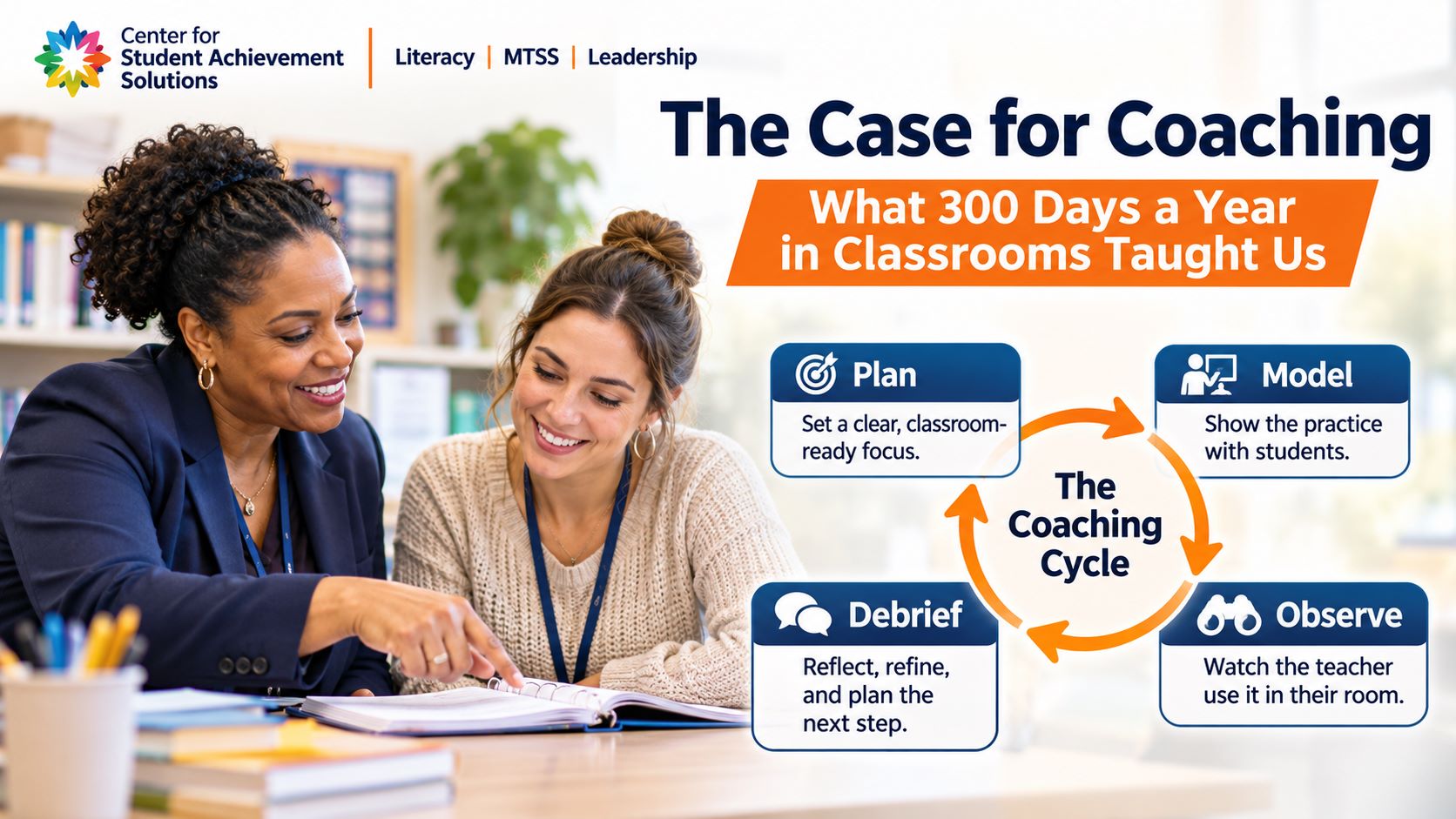
Our coaches spend more than 300 days a year inside classrooms across 87 partner schools in multiple states, and the model is deliberately unglamorous: pair every training strand with cycles of model, observe, debrief in the teacher’s own room within the same week, start with the willing so momentum does the recruiting, keep it strictly non-evaluative, and protect the time on the master schedule. The result we point to is the one that was verified: in the Brooklyn district where this model ran, all eleven partner schools improved for three consecutive years, through principal turnover, with one building’s kindergarten rising from 25 to 86 percent at benchmark in a year. The materials barely changed. The adults beside the teachers did.
|
Workshops rent knowledge. Coaching buys practice, and practice is the only thing students ever receive. |
The economics a cabinet can act on
The move is a reallocation, not an increase: shift budget share from one-time sessions toward sustained cycles, and judge the line the way you judge any investment, by cost per changed classroom rather than cost per seat filled. Three questions sort any provider, including us: What is the dosage, in cycles per teacher, not hours of training? Who does the coaching, and what is their classroom credibility? And what evidence of transfer will you show me by November, in walkthrough look-fors a principal can see? Providers with real models answer gladly. This is also the honest context for why most PD fails by November: the failure was never teachers’ willingness. It was a design that stopped at the workshop door, and coaching is simply the design that walks through it, which makes it the single most direct purchase a district can make against the implementation gap.
Pressure-test your PD budget before you sign it.A thirty-minute strategy call: bring the professional learning line and we will map it against the dosage research, show you the reallocation our partner districts made, and leave you the framework either way. |
FAQ
Does instructional coaching improve reading outcomes?
Yes, with unusually strong evidence: Kraft, Blazar, and Hogan’s 2018 meta-analysis found coaching produced large improvements in teaching practice and meaningful gains in student achievement, and field results from sustained coaching models, like eleven partner schools improving three straight years, align with it.
What does the research say about coaching versus workshops?
Workshops build knowledge but rarely change classrooms on their own: Joyce and Showers found training transfers for only a small fraction of teachers without follow-up, while adding coaching lifts implementation to roughly 95 percent. TNTP’s The Mirage showed heavy workshop-style spending with no clear practice change.
What does a year of coaching look like in practice?
Cycles, not visits: the coach models with the teacher’s own students, observes the teacher running the practice days later, and debriefs the same week, repeating until the practice is automatic. At CSAS that amounts to 300-plus coaching days a year across 87 partner schools, paired with every training strand.
About the author: Dr. Chandra Williams, Ed.D., is the founder and CEO of the Center for Student Achievement Solutions. A career educator who spent eight years as a school principal, she leads CSAS’s partnerships with schools and districts nationwide, including a multi-year Brooklyn partnership where all eleven partner schools improved for three consecutive years. Her team delivers structured literacy coaching, MTSS and reading intervention systems, and literacy leadership development, built on one conviction: educators do not need another vendor. They need a partner in the building.
References: Kraft, M. A., Blazar, D., and Hogan, D. (2018), The Effect of Teacher Coaching on Instruction and Achievement, Review of Educational Research. Joyce, B., and Showers, B. (2002), Student Achievement Through Staff Development, 3rd ed. TNTP (2015), The Mirage. District results verified against Acadience Reading source data.