
| The short answer:
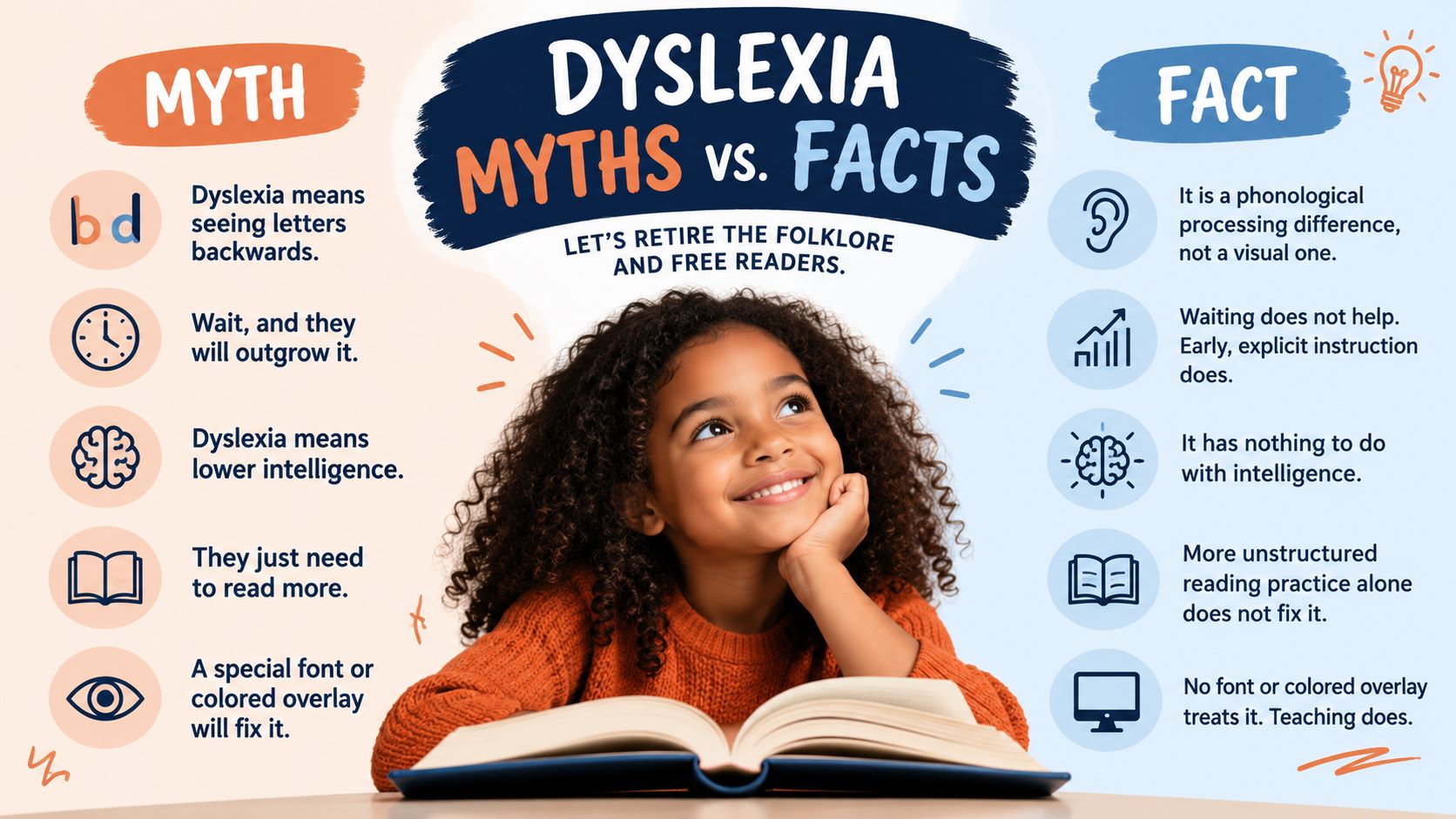
the dyslexia myths and facts that matter most this Awareness Month: dyslexia is not seeing letters backwards; it is a phonological processing difference, as the International Dyslexia Association’s definition makes clear. Children do not outgrow it by waiting, it has nothing to do with intelligence, more unstructured reading practice alone does not fix it, and no font or colored overlay treats it. What works is explicit, systematic, structured literacy instruction, started early, and students with dyslexia who receive it learn to read. Every myth retired this month frees a reader somewhere. |
October is Dyslexia Awareness Month, and awareness is worth having only if it is accurate. An estimated one in five students shows some symptoms of dyslexia on the continuum of reading difficulty, which means every classroom in America holds children whose futures depend on the adults around them believing the facts instead of the folklore. So let us retire the folklore, myth by myth, with the respect these readers deserve.
Myth one: dyslexia means seeing letters backwards
The most famous myth is also the most wrong. The International Dyslexia Association (2002) defines dyslexia as a specific learning disability, neurobiological in origin, characterized by difficulties with accurate and fluent word recognition that typically result from a deficit in the phonological component of language. The challenge lives in the sound system, mapping speech sounds to print, not the visual system. Letter reversals? Nearly all young writers make them; they are a developmental stage of handwriting, not a diagnostic sign. A child with dyslexia sees the page exactly as you do. What differs is how the brain processes the sounds the letters stand for.
Myth two: wait, and they will outgrow it
Waiting is the most expensive advice in education. Torgesen (2004) documented that students who leave the primary grades as poor readers almost never catch up without intervention markedly more intensive than what they missed. Dyslexia is lifelong; waiting does not cure it, it only compounds the gap and the shame. The hopeful flip side is just as established: identified early and taught explicitly, these students learn to read. Early is not merely better. Early is cheaper in every currency a child owns.
Myth three: dyslexia means lower intelligence
Dyslexia occurs across the full range of intelligence, which is precisely what makes it so confusing for families: a child who reasons, builds, and talks circles around her peers, yet collides with the printed word. These are often our most creative problem-solvers, and they have spent their school lives being quietly misread. The IDA definition says it plainly: the difficulties are unexpected in relation to other cognitive abilities. Believe the unexpectedness, and you stop mistaking a decoding difference for a thinking deficit.
Myth four: they just need to read more
Practice helps every reader, but unstructured practice cannot teach what was never made explicit. The National Reading Panel (2000) established that systematic, explicit instruction in phonemic awareness and phonics is what builds word recognition, and Ehri’s work on orthographic mapping (2014) explains why students with dyslexia need more repetitions of exactly that explicit mapping, not more time guessing at books beyond their code. Structured literacy, explicit, systematic, cumulative, diagnostic, is not a special education accommodation. It is simply reading instruction honest enough to work for the readers who cannot compensate around weak teaching.
Myth five: a special font or colored overlay will fix it
Because dyslexia is phonological, not visual, products aimed at the eyes keep disappointing the research. No font, lens, or overlay has credible evidence of treating dyslexia, and every dollar and month spent there is a dollar and month not spent on the instruction that does work. The kindest thing an educator can say to a hopeful family is the true thing: the treatment for dyslexia is teaching, and it is teaching we know how to do.
| Dyslexia has never once meant a child cannot learn to read. It means the teaching has to be worthy of the learner. |
What to do with the facts
Screen early and take the flags seriously, verifying with a quick diagnostic rather than waiting. Deliver explicit, structured instruction in the core so students with dyslexia are served by Tier 1 first, with intensity layered on as data demands. And this month, when the myths surface in a meeting or a hallway, retire one out loud. That is what awareness is for, and it is one more way we close the implementation gap for the readers it costs the most.
Five good minutes, once a month.The Click is our monthly letter for educators who build readers: one honest argument, one research translation, one move you can make for every reader in the room. Free, every second Tuesday. |
FAQ
Is dyslexia seeing letters backwards?
No. Dyslexia is a phonological processing difference, difficulty mapping speech sounds to print, as the International Dyslexia Association’s definition states. Letter reversals are a normal developmental stage for nearly all young writers and are not a diagnostic sign of dyslexia.
Do children outgrow dyslexia if we wait?
No. Dyslexia is lifelong, and research shows struggling readers rarely catch up without markedly intensified instruction; waiting only compounds the gap. The encouraging fact is the reverse: identified early and taught with explicit, structured literacy, students with dyslexia learn to read.
What actually helps students with dyslexia learn to read?
Explicit, systematic, cumulative instruction in the sound-to-print system, structured literacy, delivered early, with more practice repetitions and intensity as data demands. Fonts, colored overlays, and unstructured reading practice do not treat dyslexia; teaching does.
About the author: Dr. Chandra Williams, Ed.D., is the founder and CEO of the Center for Student Achievement Solutions. A career educator who spent eight years as a school principal, she leads CSAS’s partnerships with schools and districts nationwide, including a multi-year Brooklyn partnership where all eleven partner schools improved for three consecutive years. Her team delivers structured literacy coaching, MTSS and reading intervention systems, and literacy leadership development, built on one conviction: educators do not need another vendor. They need a partner in the building.
References: International Dyslexia Association (2002), Definition of Dyslexia. Torgesen, J. K. (2004), Avoiding the Devastating Downward Spiral. National Reading Panel (2000), Teaching Children to Read. Ehri, L. C. (2014), Orthographic Mapping in the Acquisition of Sight Word Reading.