
| The short answer:
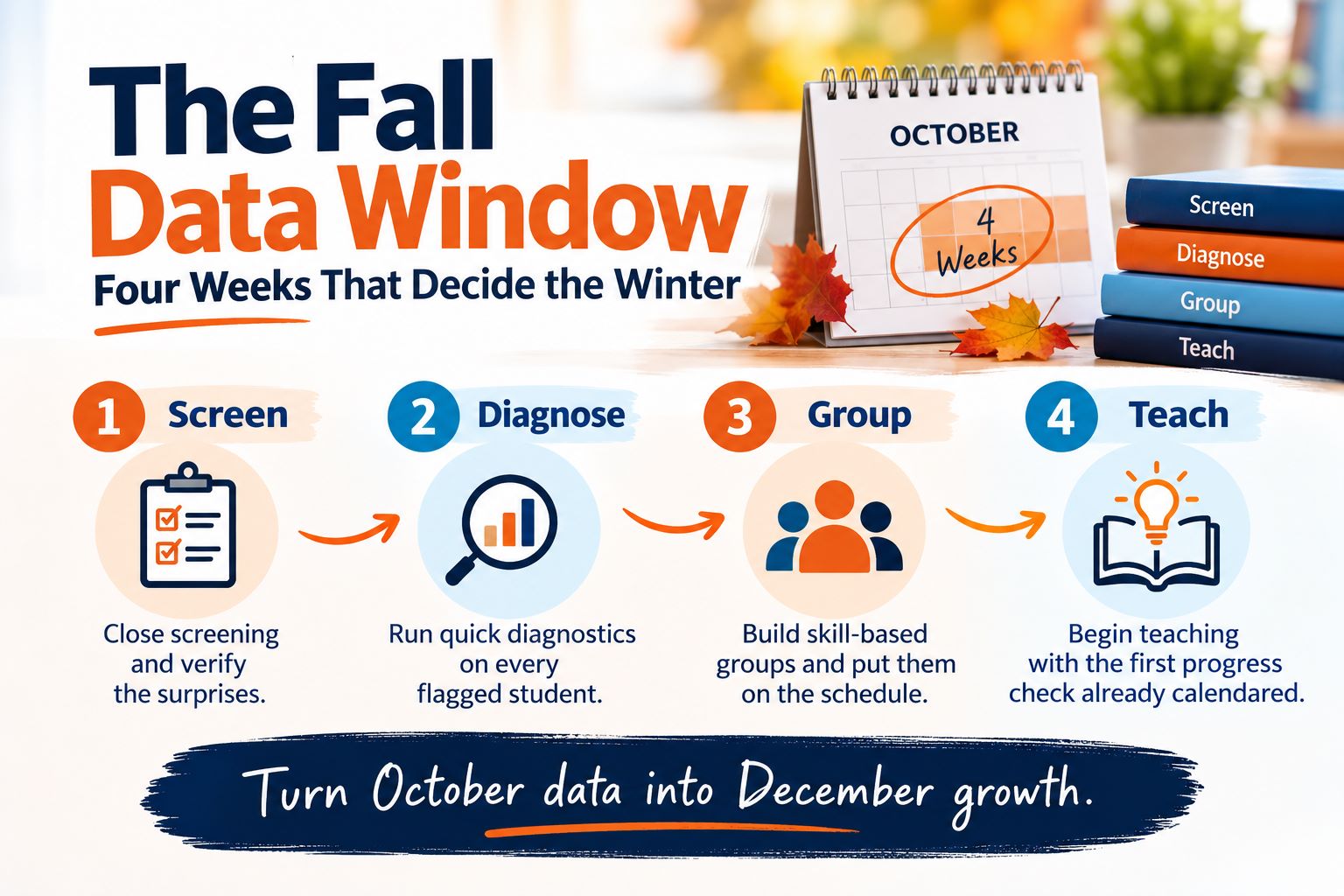
the fall benchmark data window is the roughly four weeks after screening closes, and it runs on one unforgiving fact: screening data has about a 30-day shelf life, because it describes readers who keep moving. The sequence that beats the clock is screen, diagnose, group, teach: week one, close screening and verify the surprises; week two, run quick diagnostics on every flagged student; week three, build skill-based groups and put them on the schedule; week four, teach, with the first progress check already calendared. Schools that finish the sequence by early November spend the winter growing. Schools still forming groups in December spend it catching up to their own data. |
Right now, in thousands of schools, the fall screening window has closed and a quiet race has started that most buildings do not know they are running. The data is complete, the dashboards are lit, and every day that passes makes the numbers a little less true, because the students they describe keep learning, sliding, and changing while the adults deliberate. Four weeks from now, that data will be a photograph of children who no longer exist. Here is how our partner schools spend those four weeks.
Week one: close the window and verify the surprises
Finish make-up assessments fast, then read the data for shocks before decisions: the strong reader who tanked, the summer bloomer the spring list missed. A five-minute recheck on the genuine surprises protects you from building a month of groups on one bad morning. This is also the week the placement meeting happens, because it was calendared before the data existed, and written decision rules, which score sends which student to which verification, turn the meeting from debate into application.
Week two: diagnose, because the screener cannot
The composite flagged who; now five to ten minutes per flagged student finds where: the quick skill inventories in phonemic awareness, letter-sounds, and decoding patterns that produce the one sentence a screener never can: the breakdown is here. Torgesen (2004) made the stakes of this step plain decades ago; intensity only works when it is aimed.
Week three: build groups that can be taught, and schedule them
Groups form around a shared teachable skill, the vowel-team group, the blending group, each with an entry point, an exit criterion, and a review date 6 to 8 weeks out. Then the schedule does its part: intervention lands in the supplemental band, adding minutes rather than stealing them, and a flooded list gets read honestly as a Tier 1 signal with core fixes launched in parallel.
Week four: teach, with the check-back already on the calendar
Instruction starts, progress monitoring starts with it, and the first check-back meeting is already scheduled, because a group without a review date is a group that will still exist, unchanged, in March. By the end of week four the window has done its job: every flagged reader is in aimed instruction, every group has an expiration date, and the building has converted a data event into a teaching system.
| Screening data does not age like wine. It ages like produce. |
The November 1 test
One month from screening, walk your building with two questions: can every interventionist tell you the skill target of each group, and does every group have a review date? Two yeses mean the window worked and the winter will show it. Anything else is fixable this week, which is exactly why the window gets a playbook instead of a hope. It is the season’s clearest chance to close the implementation gap while it is still cheap.
Run the four weeks with the playbook.The Fall Data Window Playbook: the week-by-week sequence, the quick diagnostic checklist, the decision rules template, and the group-building protocol, free and built for right now. |
FAQ
What is the fall data window?
The roughly four weeks after fall screening closes, when the data is fresh enough to act on. Strong systems use it to run a fixed sequence, screen, diagnose, group, teach, so every flagged student is in aimed instruction by early November.
How long is screening data useful?
About 30 days for placement decisions. Screening describes readers at a moment, and readers keep moving, so groups built in December from October data are built on students who no longer exist. Decide within the window or rescreen informally before deciding.
What are the four steps from screening to instruction?
Screen and verify the surprises in week one, run quick diagnostics on flagged students in week two, build skill-based groups with entry and exit criteria and schedule them in week three, and begin teaching in week four with the first progress check already calendared.
About the author: Dr. Chandra Williams, Ed.D., is the founder and CEO of the Center for Student Achievement Solutions. A career educator who spent eight years as a school principal, she leads CSAS’s partnerships with schools and districts nationwide, including a multi-year Brooklyn partnership where all eleven partner schools improved for three consecutive years. Her team delivers structured literacy coaching, MTSS and reading intervention systems, and literacy leadership development, built on one conviction: educators do not need another vendor. They need a partner in the building.
References: Torgesen, J. K. (2004), Avoiding the Devastating Downward Spiral. National Reading Panel (2000), Teaching Children to Read. District results verified against Acadience Reading source data.