
|
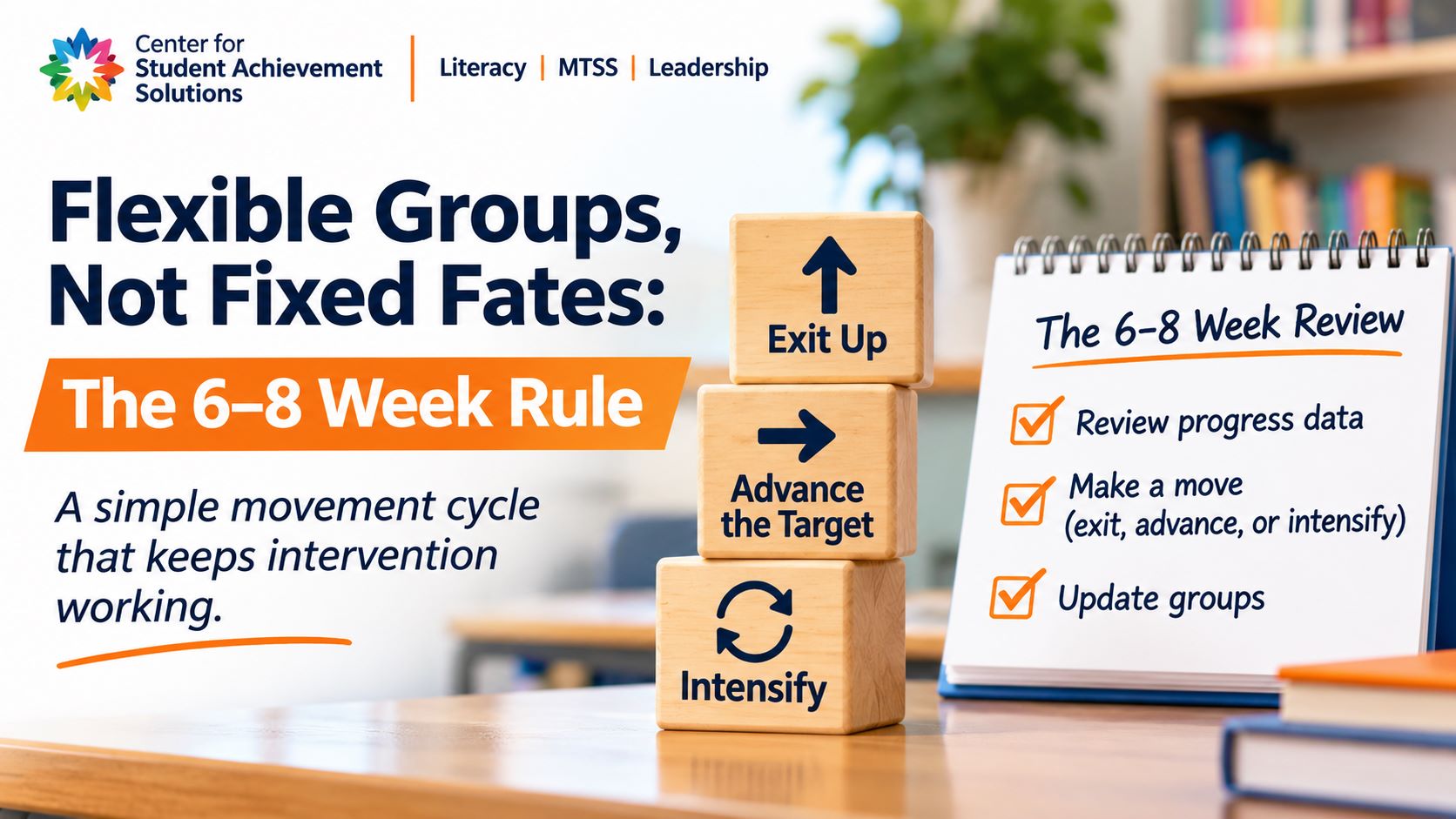
The short answer: flexible grouping in reading intervention runs on one rule: every group is reviewed against written criteria every 6 to 8 weeks, and something moves: students exit up, skill targets advance, or intensity rises. Groups are named for skills, not levels, progress monitoring feeds the review, and exits get celebrated out loud. The test is simple and worth running this week: if your October groups would still look the same in March, that is not intervention. That is tracking wearing an MTSS lanyard. |
The groups you built this month were built honestly, from real data, with real care. Here is the uncomfortable thing I have learned auditing hundreds of intervention schedules: the honesty of October is not the risk. The risk is that nothing is scheduled to disturb those groups again, and a group nobody is scheduled to question quietly hardens from a treatment into an identity. Children can tell you which group they are in by Halloween. The question is whether the group can still change by Thanksgiving.
Why 6 to 8 weeks
The interval is where the evidence meets the logistics: long enough for targeted instruction to produce measurable movement on progress monitoring, short enough that a wrong placement cannot consume a semester. Torgesen (2004) framed the stakes: the window for catching readers up narrows every month, so the system’s willingness to re-decide is itself an intervention. A review every 6 to 8 weeks means a student’s year contains four or five chances to be re-seen, instead of one placement and a long wait for spring.
Name groups for skills, not fates
The vowel-team group. The blending group. The fluency-builders. Skill names do quiet, powerful work: they declare what the group is for, which means they declare when it ends, the day the skill is secure. Level and color names (the red group, the low group) describe children instead of work, and descriptions of children have a way of becoming permanent. This is the same logic that built the groups in the first place, diagnosing the skill instead of trusting the composite: the group exists because of a teachable thing, so the teachable thing gets the name.
The review, and the three moves it can make
1. Exit up. The skill is secure on two or three consecutive progress checks: the student graduates to core-plus-monitoring, and the seat opens. Written exit criteria, set when the group formed, make this a rule being applied, not a debate being won.
2. Advance the target. Blending is solid, so the group’s work moves to vowel teams: same students for now, new teachable thing, new exit line.
3. Intensify. Faithful instruction, honest attendance, flat line: the plan changes, smaller group, more minutes, tighter cycle, because repeating a dose that is not working is not persistence.
Every review runs inside the 45-minute data meeting, where each move gets an owner and a date, and a list that keeps growing instead of cycling gets read for what it is: a Tier 1 signal.
| A group with no exit criteria is not a group. It is a destination. |
Celebrate the exits like they matter, because they do
When a reader graduates a group, say so, specifically and publicly enough to count: you blended your way out, and we watched you do it. What gets celebrated gets repeated, by the student who leaves and by every student still working, because exits prove the groups are doors, not rooms. Run the rule from now to winter break, two full cycles, and your January self will inherit groups that reflect January readers, which is the whole promise of MTSS kept at classroom scale, and one more honest closure of the implementation gap.
Get the decision rules and review protocol.The Fall Data Window Playbook includes the 6-8 week review criteria, the exit-rule templates, and the group movement tracker, free and ready for your first review cycle. |
FAQ
How often should reading intervention groups change?
Every group gets a formal review against written criteria every 6 to 8 weeks, and something moves each cycle: students exit, the skill target advances, or intensity rises. The interval is long enough to measure real progress and short enough that no misplacement lasts a semester.
What decision rules govern group movement?
Written entry and exit criteria set when the group forms: which progress monitoring scores, sustained across two or three checks, graduate a student, advance the target, or trigger intensification. Rules written in advance turn the review into application instead of debate.
What is the difference between flexible grouping and tracking?
Movement. Flexible groups are named for skills, carry exit criteria, and change every 6 to 8 weeks as data dictates; tracking sorts students into standing groups that describe them rather than the work. If the groups would look the same in March, the system is tracking, whatever it is called.
About the author: Dr. Chandra Williams, Ed.D., is the founder and CEO of the Center for Student Achievement Solutions. A career educator who spent eight years as a school principal, she leads CSAS’s partnerships with schools and districts nationwide, including a multi-year Brooklyn partnership where all eleven partner schools improved for three consecutive years. Her team delivers structured literacy coaching, MTSS and reading intervention systems, and literacy leadership development, built on one conviction: educators do not need another vendor. They need a partner in the building.
References: Torgesen, J. K. (2004), Avoiding the Devastating Downward Spiral. District results verified against Acadience Reading source data.